How to start investing with little money
How to Start Investing with Little Money
The Importance of Just Getting Started
1) Building the habit: Starting to invest, even with small amounts, helps you develop a savings and investing habit. This financial discipline will serve you well as your income grows over time.
2) Learning the ropes: Beginning with smaller amounts allows you to learn about different investment options and strategies without risking significant capital. It’s a chance to gain experience and confidence.
3) Overcoming inertia: Often, the hardest part of any journey is taking the first step. By starting to invest now, you overcome the mental barrier that might be holding you back.
Developing Your Savings and Investing Muscle💪
1) Start Small: Begin by setting aside a small, fixed amount each month for investing. Even $20 or $50 a week can make a huge difference over time.
2) Increase Gradually: As you become more comfortable with investing, try to increase your contributions over time.
3) Stay Consistent: Regular, consistent investing is key. Set up automatic transfers to ensure you stick to your plan.
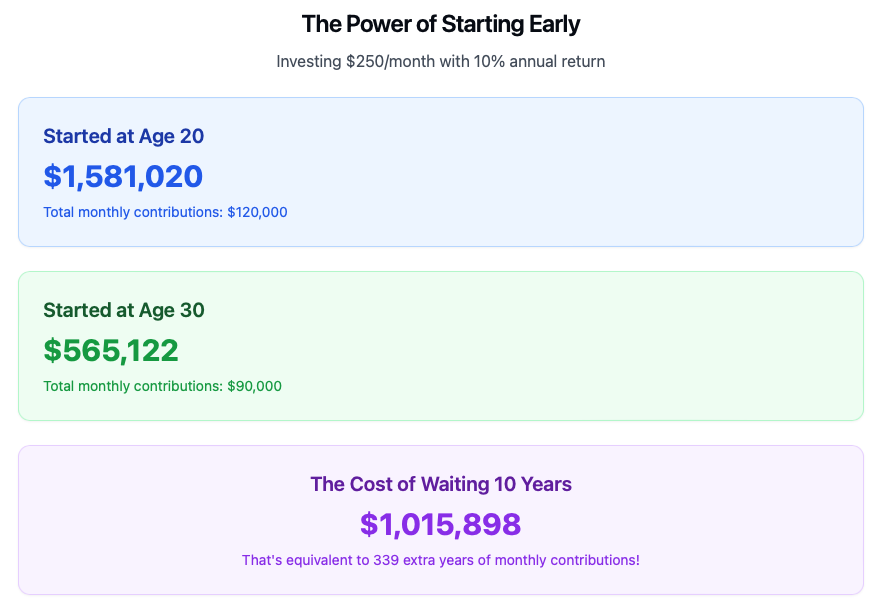
The Power of Compound Interest 📈
Here’s an example:
Want to see how your retirements can grow? 🌱
Investment Plans to Consider
When starting your investment journey, it’s important to understand the different types of accounts available. Here are some popular options:
Retirement Accounts
1) 401(k): This is an employer-sponsored retirement plan. Many employers offer matching contributions, which is essentially free money. If your employer offers a match, try to contribute at least enough to get the full match.
2) Traditional IRA: Similar to a Roth IRA, but contributions are often tax-deductible now, and you pay taxes when you withdraw the money in retirement.
3) Roth IRA: This individual retirement account allows you to contribute after-tax dollars. Your money grows tax-free, and you can withdraw it tax-free in retirement. It’s a great option for young investors or those who expect to be in a higher tax bracket in retirement.
4) SEP IRA: This is a good option for self-employed individuals or small business owners.
Taxable Investment/Savings Accounts💰
1) Taxable Brokerage Account: An account with a brokerage like Fidelity, E*Trade, Charles Schwab which allows you to invest in stocks, bonds, index funds, etc.. While you won’t have the tax benefits if a retirement account, these accounts provide more freedom and flexibility in how and when you use your money
2) High Yield Savings Account: These accounts offer a higher interest rate than a traditional savings account with the same FDIC insurance coverage. A great place to park some cash for emergencies or other short term needs
3) Certificate of Deposits (CDs): A type of savings account offered by Credit Unions or Banks which typically offer a higher interest rate than a standard savings account but do not allow for withdrawals for a specified amount of time without incurring fees.
Options to Start Investing with Little Money
1) Index Funds: These low-cost funds track a market index and offer broad market exposure.
2) Mutual Funds: While some mutual funds require higher minimal initial investments, there are plenty of options with very low initial investments to get you started on your investing journey.
3) Exchange-Traded Funds (ETFs): These offer diversification and can be purchased for the price of a single share.
4) High Yield Savings Accounts: While not technically investing, these can be a good starting point for building your financial foundation.
Understanding the Risks⚠️
The Risks of Not Investing
Resources for Beginner Investors
Books:
1) The Simple Path to Wealth by JL Collins
2) Set for Life by Scott Trench
3) The Little Book of Common Sense Investing by John C. Bogle
Websites and Online Courses:
1) Investopedia.com – A comprehensive resource for financial education
2) Khan Academy’s personal finance courses – Free in-depth lessons on investing and personal finance
3) Yahoofinance.com: For investment research, analysis, and personal finance article
Podcasts:
1) The Ramsey Show – Focuses on getting out of debt and financial discipline
2) Afford Anything – Great for understanding the psychology of money
3) Stacking Benjamins – Makes finance fun and accessible
Conclusion

Should You Pay Off Debt or Invest First

Should You Pay Off Debt or Invest First?
Should You Pay Off Debt or Invest First? 💭
It’s one of the most common questions in personal finance — should you pay off debt first or start investing? The answer depends on your financial situation, but if you’re carrying high-interest debt (especially consumer debt like credit cards 💳), the smartest move is almost always to tackle that first.
The Heavy Cost of Debt Over Time 💸
Let’s look at how expensive debt can really be. Imagine you have $10,000 in credit card debt with an interest rate of 20%. Even if you commit to paying a fixed $200 per month (which is more than most minimum payments), the numbers are shocking.
Take a look at what that debt will actually cost you:
💳 The True Cost of Credit Card Debt
Making a Fixed $200 Monthly Payment
That’s $11,680 that could have been invested, saved, or used to build your financial future — instead, it goes to the bank. 💸
💡 Want to See Your Own Numbers?
Use our free Credit Card Interest Cost Calculator to find out exactly how much your debt is costing you and how long it will take to pay off with different payment amounts.
Try the Calculator →That’s $11,680 in interest alone — more than the original amount you borrowed! Over 9 years, you’ll pay back $21,680 total for that $10,000 purchase. And this assumes you never add another dollar to that balance. 😳
That’s money that could have been invested or saved for your future — but instead, it’s being handed over to the bank month after month. When you think about it that way, paying off debt becomes one of the best “investments” you can make.
The Freedom of Being Debt-Free ✨
There’s something powerful about being debt-free. It’s not just about the numbers — it’s about the peace of mind that comes with knowing you don’t owe anyone anything. That feeling of freedom changes the way you think, spend, and invest.
People who’ve paid off their debt often experience a major mindset shift. Instead of feeling trapped or anxious about payments, they’re free to focus on building wealth, not just surviving from paycheck to paycheck. They start viewing money as a tool for growth, rather than a burden.
That shift — from debt-driven to purpose-driven — is one of the most important transformations on the journey to financial independence. 💪
When It Might Make Sense to Invest First 📈
There are a couple of exceptions where investing before fully paying off debt makes sense:
- Employer Retirement Match: If your company offers a 401(k) match, it’s essentially free money. I’d prioritize contributing at least enough to get that match — but if your debt has an extremely high interest rate (like 25% on a credit card), I’d still consider pausing investing temporarily to attack that balance first.
- Mortgage Debt: Mortgage rates are generally much lower and may offer tax benefits. Because of that, paying off a home loan early isn’t always the best use of extra cash — especially if your money could earn more invested elsewhere.
Outside of those exceptions, focusing on paying down debt will almost always provide the best long-term benefit. Once you’re free from high-interest balances, you can redirect those monthly payments straight into your investment accounts — and that’s when your wealth really starts to grow. 🚀
Final Thoughts 💬
Paying off debt isn’t just about getting ahead financially — it’s about taking back control. The peace of mind that comes with being debt-free is worth more than any short-term investment gain. Once your high-interest debts are gone, you’ll be in a much stronger position to invest consistently and build lasting wealth.
Remember: the goal isn’t just to have more money — it’s to have freedom, security, and confidence in your financial future. And that starts with getting rid of the debt that’s holding you back. 💯